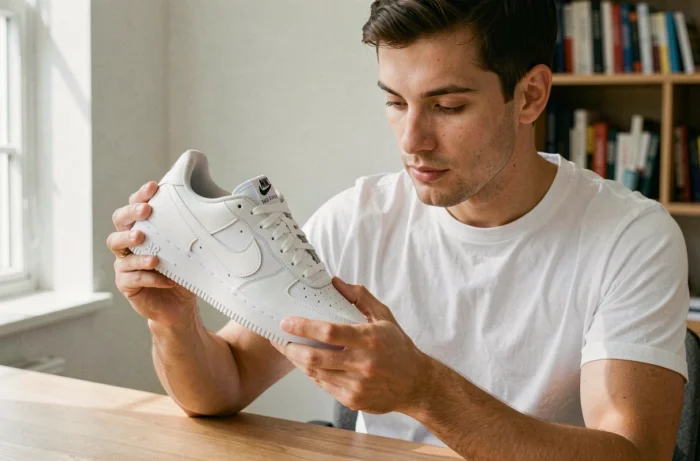
You have just received a pair of Nikes purchased from a marketplace or from a private seller. Before even wearing them, a reflex can help you avoid a nasty surprise: check the Nike serial number printed on the inner label. This code, often referred to as the style code or SKU, is the starting point for authenticating your sneakers. But be careful, its mere presence does not guarantee that the pair is legitimate.
Why a valid Nike SKU code does not prove authenticity
Most online guides suggest comparing the SKU from the inner label with that on the box, then searching for it online. This is a useful step, but it has a limit that many sources overlook.
A real identifier can be copied onto a counterfeit. The SKU confirms that a model exists in the Nike catalog. It does not prove that the shoe you hold in your hand comes from an authorized factory. Counterfeiters reproduce authentic codes on their labels, making verification of the number alone insufficient.
Nike does not offer a public registry to directly validate each style code with the brand. Third-party services that advertise “verification” rely on community databases or product catalogs. Their result is an indication, not a certificate. To delve deeper into this topic, you can visit Lydie Tendances which details common pitfalls related to this verification.
In practical terms, consider the SKU as a first filter. If the code does not match any known model, the pair is suspicious. If it matches, you are not yet in the clear.
Reading the Nike inner label: elements to compare
The label sewn inside the shoe (often on the tongue or under the collar) contains several pieces of information. Each deserves a cross-check.
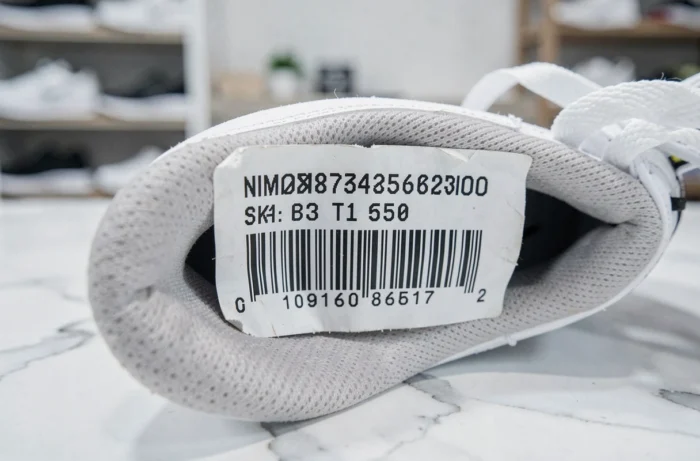
- The style code (SKU) appears as two sequences separated by a dash, for example, 315122-111. This code identifies the model and colorway. It must be strictly identical on the label of the right shoe, the left shoe, and on the side of the box.
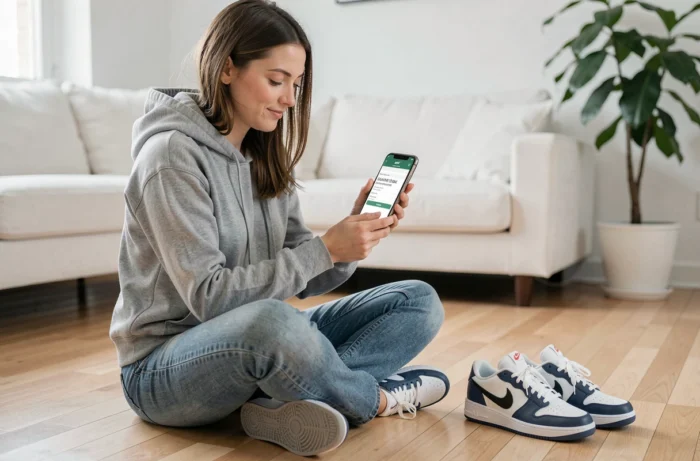
- The UPC/EAN barcode, located under the SKU, corresponds to the exact size of the pair. You can verify it through the GEPIR database, an international directory that lists barcodes assigned to manufacturers. If the code points to a company unrelated to Nike, it is a strong warning signal.
- The size, country of manufacture, and production date are also on the label. On an authentic pair, this information is printed clearly, with regular alignment and consistent typography. Blurry, misaligned, or variable-sized characters often indicate a counterfeit.
Make it a habit to photograph the label of each pair you buy. In case of later doubt, this image facilitates any verification process.
QR codes and NFC chips on Nike sneakers: real reliability
In recent years, Nike has integrated QR codes and sometimes NFC chips into certain models. These technologies are presented as anti-counterfeiting tools. Their reliability deserves to be nuanced.
Counterfeits can incorporate a fake QR code or NFC chip. Some redirect to a generic page, a third-party link, or a page unrelated to the model being examined. The useful check is to verify that the QR code indeed points to an official Nike domain (nike.com) and that the displayed information exactly matches the model, colorway, and size of your pair.
If scanning the QR code opens a blank page, an unknown site, or an error message, treat it as a negative signal. Conversely, a functional QR code that points to the correct Nike product page increases the likelihood of authenticity, though it does not guarantee it by itself.
Cross-referencing signals rather than relying on a single tool
None of these digital elements, taken in isolation, constitute proof. Reliable verification relies on cross-referencing multiple signals: SKU consistency, barcode validity, QR code destination, and physical inspection of the pair.
Physical inspection: details that the serial number does not reveal
The serial number informs you about the model, not the quality of manufacturing. It is the physical examination that completes the picture.
Compare the suspicious pair with high-resolution photos of the same model, published on the official Nike site or on recognized authentication platforms. Focus on three areas:
- The Swoosh: its shape, positioning, and proportions vary by model but remain symmetrical between the right and left foot. A thicker Swoosh on one side, misaligned, or with irregular edges indicates a copy.
- The stitching: on an authentic pair, it is consistent, with no loose threads. Pay particular attention to the junctions between panels of leather or fabric.
- The insole and foam: the comfort to the touch, the density of the foam, and the imprint of the logo under the insole are indicators that are difficult for counterfeiters to replicate. Foam that is too rigid or too thin compared to the original model is suspicious.
Third-party authentication services
If doubts persist after your checks, specialized services offer authentication by sending photos or physical examination. These platforms employ experts who analyze every detail by comparing it with databases of verified pairs. The cost remains modest compared to the loss associated with purchasing a counterfeit.
Keep in mind that no single method replaces a bundle of converging clues. A consistent SKU, a verifiable barcode, a QR code pointing to nike.com, careful finishes, and traceable provenance together form the best defense against Nike sneaker counterfeits. The most effective reflex remains to buy from authorized retailers or platforms that guarantee authenticity before shipping.