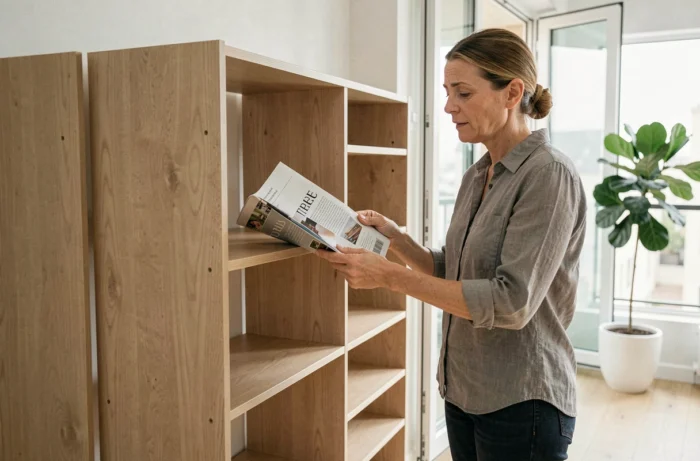
You have just assembled your new Ikea furniture and a sharp smell fills the room. This reaction is normal: particle boards, MDF, and adhesive resins release volatile organic compounds (VOCs) as soon as they are unpacked. The question of ventilation time comes up systematically, and the answer depends on parameters that most guides do not detail.
Composite panels and resins: what produces the smell of new Ikea furniture
Particle board and MDF are made from wood fibers or particles bonded by resins, often based on formaldehyde. It is this substance that generates the characteristic smell of furniture just out of the box.
Melamine or laminate finishes add an extra layer of emissions. A piece of furniture like a BILLY bookshelf or a PAX wardrobe combines several types of emitting surfaces: thin panel back, particle board shelves, plastic-covered edges.
The key information to understand the recommended ventilation for Ikea furniture is based on one principle: each side of the panel emits VOCs independently. A shelf placed against a wall only ventilates one of its two sides, which slows down the process.
Actual ventilation duration: why 48 hours is not always enough
The most commonly cited range is 48 to 72 hours. This benchmark corresponds to the drop in the initial emission peak, the moment when the most volatile VOCs evaporate massively. In practice, the smell significantly decreases after three days of ventilation with windows open.
But the absence of smell does not mean the absence of pollutants. Some composite materials continue to emit traces for several weeks, even months. For a standard room (living room, office), three days of active ventilation is a reasonable minimum.
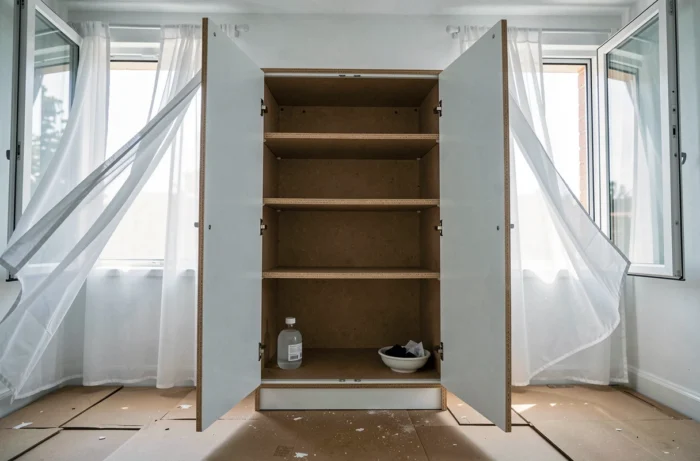
For a child’s room or a sleeping area, extending ventilation beyond a week is more prudent. Sensitive rooms deserve an extended ventilation period, especially if natural ventilation is limited.
What speeds up or slows down off-gassing
Temperature plays a direct role. Heat accelerates the evaporation of VOCs, but without air circulation, vapors stagnate in the room. Heating without opening windows is counterproductive.
Humidity also plays a role: humid air can slow down the evaporation of certain compounds. Furniture assembled in winter, in a heated and poorly ventilated home, takes longer to lose its smell than furniture installed in summer with a draft.
- High temperature with windows open: significantly accelerates off-gassing
- Continuous mechanical ventilation: complements window opening, evacuating pollutants even when closed
- Panels exposed on all sides before assembly: reduces overall ventilation time as each emitting surface is treated
- Closed room with heating: concentrates VOCs without evacuating them, to be absolutely avoided
Effective ventilation method for particle board furniture
Have you noticed that assembly instructions never mention ventilation? The most effective method starts even before assembly.
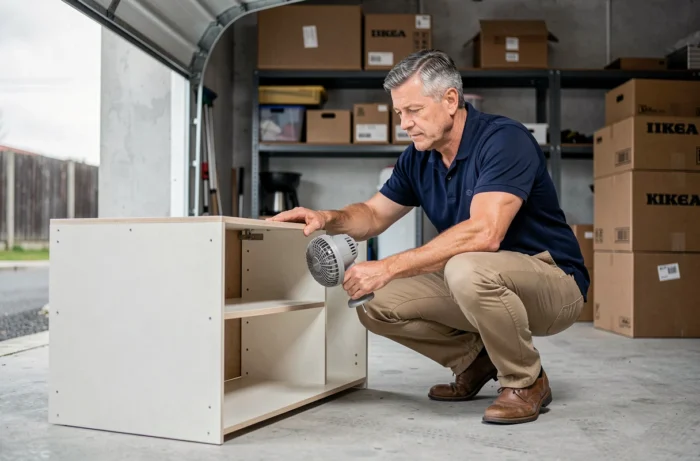
Unpacking the panels and laying them flat in a ventilated room for 24 hours allows all emitting surfaces to be exposed. This step significantly reduces the smell once the furniture is assembled.
During and after assembly
Once the furniture is assembled, open all doors, all drawers, and remove removable shelves if possible. The goal is to increase the surface area in contact with the ambient air.
Place the furniture away from the wall (about ten centimeters is sufficient) so that the back panel, often the thinnest and most emitting, can breathe. Do not store anything in the furniture during the first three days: clothes and linens absorb VOCs and retain the chemical smell for weeks.
A often overlooked point: do not turn off the mechanical ventilation during ventilation. Opening windows and mechanical ventilation are complementary. The mechanical ventilation ensures continuous evacuation, even at night when you close the windows. Check that the air inlets and extraction vents are not blocked.
Absorbing residual odors: baking soda and white vinegar
After the active ventilation phase, a light smell may remain, especially in the closed spaces of the furniture (drawers, cabinets). Two common products help neutralize these residues.
Baking soda absorbs odors without masking emissions. Sprinkle it at the bottom of drawers and on shelves, let it sit overnight, then vacuum. This operation can be repeated several times.
White vinegar, placed in a bowl inside the closed furniture, captures certain volatile compounds. Renew the bowl daily for two to three days. These two methods do not replace ventilation; they complement it for persistent odors.
- Baking soda: sprinkle, let sit overnight, vacuum, repeat if necessary
- White vinegar in a bowl: renew daily for two to three days
- Activated charcoal: an alternative to baking soda, effective in confined spaces like deep drawers
When to consider the furniture ready for daily use
No standard sets a mandatory ventilation duration for the consumer. European regulations impose emission limits on manufacturers, not a ventilation protocol after purchase.
In practice, furniture is ready when the smell has disappeared and the room smells nothing after a night with windows closed. If a smell persists upon waking, continue ventilation. This simple test remains the most reliable for home use.
For sensitive individuals, young children, or poorly ventilated rooms, planning two weeks of regular ventilation before normal use is a reasonable precaution. Formaldehyde decreases gradually, but its complete disappearance takes time on cheap composite panels.