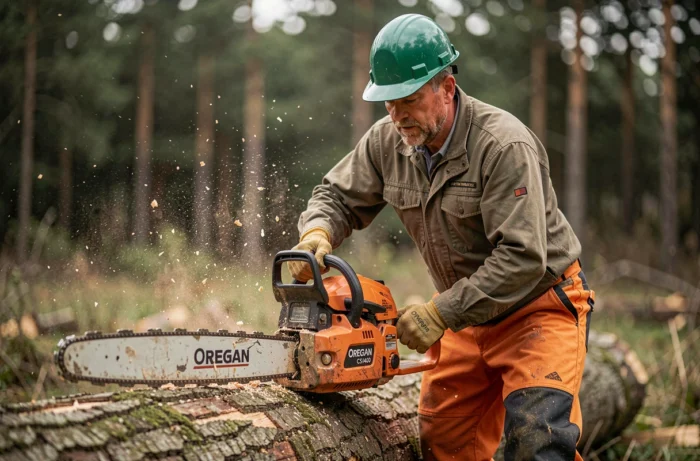
The Oregon CS1400 092 is a corded chainsaw designed for regular maintenance tasks: branch trimming, light pruning, and cutting firewood of moderate diameter. Its 2,400 W motor and 40 cm guide place it in the category of stable power domestic machines, without the need for oil-gas mixing or recharging constraints.
Chain tension and lubrication on the Oregon CS1400: two adjustments that determine longevity
The majority of cutting incidents on a corded chainsaw do not stem from the motor. They arise from a poorly tensioned chain or a neglected lubrication circuit.
On the CS1400, checking the oil level and chain tension must precede every cutting session. Insufficient lubrication flow accelerates wear on the guide and causes abnormal heating of the chain, reducing its cutting capacity and increasing the risk of kickback.
We recommend checking the tension after the first ten minutes of work: the chain loosens due to heat. Excessive play between the chain and the guide leads to lateral disengagement, a dangerous scenario during vertical cuts.
The 40 cm guide requires regular maintenance of the guide rail. Cleaning the groove and periodically flipping the guide helps balance wear on both sides. This detail, rarely mentioned in product sheets, significantly extends the guide’s lifespan.
To find out everything about the Oregon CS1400 092, the detailed specifications confirm that the machine includes an automatic lubrication system, but this does not eliminate the need for a visual check before each use.
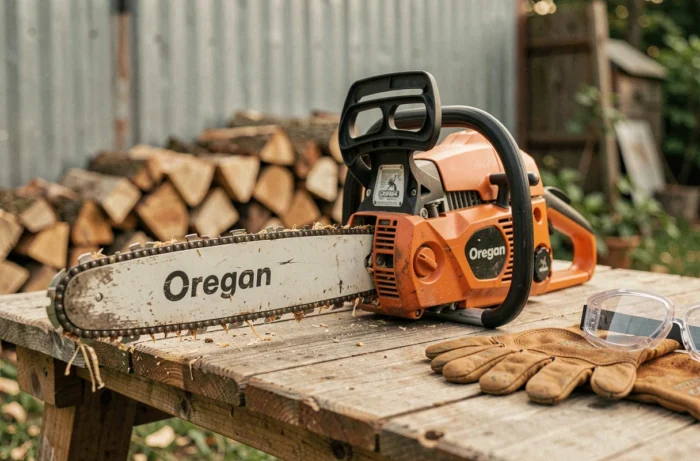
Chain speed and protective equipment: a match not to be overlooked
The choice of personal protective equipment depends on the chain speed, not just the nominal power of the motor. This technical distinction is often overlooked in consumer guides that merely list generic PPE.
Cut-resistant protections comply with the EN ISO 11393 standard, which defines classes based on the chain speed that the protective fabric must withstand. On a corded machine like the CS1400, the chain speed remains stable due to continuous power supply, unlike battery models where speed decreases with charge level.
Specifically, to work with this chainsaw, we recommend at minimum:
- A cut-resistant pant class suitable for the stated chain speed, not just a “chainsaw” pant without class mention
- Reinforced gloves with protection on the back of the left hand, the most exposed area during chain kickback
- A face shield or closed safety glasses, as chip projections during plunge cuts are particularly violent at this chain speed
- Ear protection, even though the CS1400 is quieter than a gas model (the noise is still sufficient to damage hearing during prolonged sessions)
Corded action radius: the real field constraint of the CS1400
The main limitation of this chainsaw is the action radius related to the cable, a more determining factor in daily use than the motor power. The mains power ensures constant power without gradual degradation, but it imposes total dependence on an electrical outlet and the length of the extension cord used.
On rough terrain or for pruning far from home, this constraint becomes a real operational hindrance. The extension cord must be properly sized: a cable gauge that is too low over a long distance causes a voltage drop that reduces the effective power of the motor and can damage it over time.
We observe that many users underestimate this parameter. An insufficiently gauged extension cord can cause the CS1400 to lose a significant portion of its effective power. Choosing a cable gauge suitable for the working distance is an integral part of site preparation.
Working near power lines: a specific risk
Pruning near power lines poses a particular risk, even without direct contact with a cable. Local recommendations discourage any intervention by an individual with a chainsaw or ladder in this configuration. The appropriate approach is to contact the network operator or a trained and authorized professional.
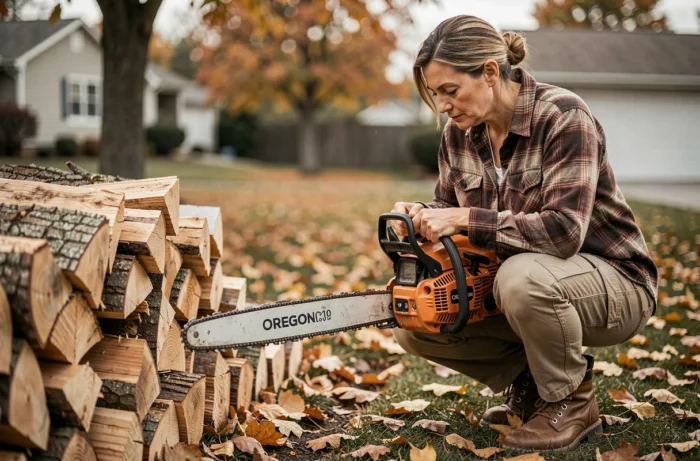
Oregon CS1400 compared to battery and gas chainsaws: concrete selection criteria
Comparing the CS1400 to a battery model or a gas model is not just about a power chart. Each type of power supply imposes different trade-offs based on actual use.
The corded chainsaw maintains a clear advantage in power stability throughout the work session. No drop in power, no recharge to plan. The start is instant, without a starter or preheating.
Compared to a gas model, the CS1400 eliminates the need for oil-gas mixing and carburetor maintenance. It is quiet between cuts, a real asset in residential areas. On the other hand, it cannot compete in terms of mobility on forest terrain or a site without mains power.
Against a battery model, the corded version offers unlimited autonomy as long as the cable follows. The battery model gains in mobility but loses in power consistency, especially at the end of the charge. The cost of the charger and additional batteries also adds to the overall budget.
- For regular garden maintenance with accessible power, the corded CS1400 represents the best power-price ratio
- For occasional interventions far from the sector, a battery model will be more suitable despite its autonomy limits
- For felling or intensive forestry work, only a gas model with a longer guide will be appropriate
The CS1500, a higher version in the Oregon range, adds the PowerSharp sharpening system that allows sharpening the chain directly on the machine. This integrated sharpening takes a few seconds and eliminates the need for a dedicated tool, a time-saving benefit for users who are continuously cutting.
The Oregon CS1400 092 remains a coherent machine for its segment: reliable, powerful within the limits of its 40 cm guide, and low maintenance in mechanical upkeep. Its true boundary is not power, but the length of the cable that connects it to the mains.