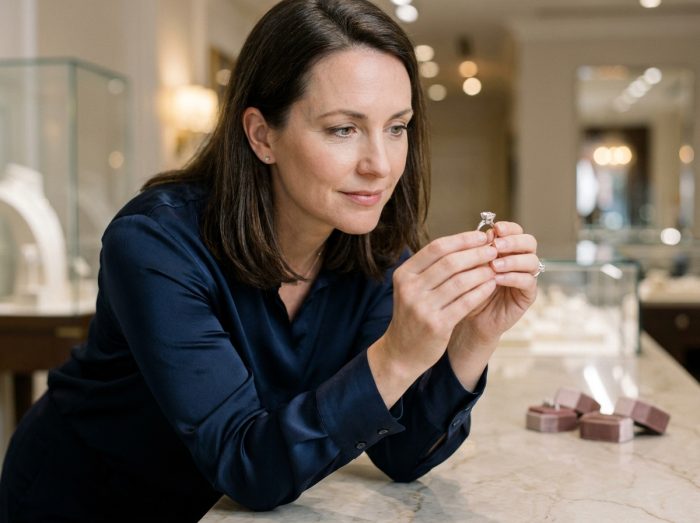
A gold ring placed in a box catches the eye even before it is touched. This magnetism is not random. The fascination for luxury rings is based on a precise blend of craftsmanship, rare materials, and personal history. Understanding what makes these pieces so desirable helps make more informed choices at the time of purchase.
Quiet luxury in jewelry: the ring that doesn’t reveal its price
Have you ever noticed that a simple ring, without a visible logo, can appear more refined than a piece covered in stones? This phenomenon has a name: quiet luxury. For a few years now, this trend has been reshaping the codes of high-end jewelry.
The principle is simple. One chooses a sleek band, a noble metal, sometimes a discreet single stone. The price remains high, but nothing in the design signals it ostentatiously. According to Bain and McKinsey, these minimalist rings appeal to young urban professionals looking for a symbol of success that is only readable by connoisseurs.
This deliberate sobriety changes the relationship to the piece. Wearing a luxury ring is no longer about displaying status, but about owning an object whose intimate quality is known: the weight of the metal, the purity of the stone, the precision of the setting.
Houses like Boucheron or Cartier now offer lines where the goldsmith’s work matters more than the size of the diamond. Some Hermès rings perfectly illustrate this approach: an identifiable design without a logo, a quality perceptible to the touch.
Luxury rings and diamonds: what carats don’t tell
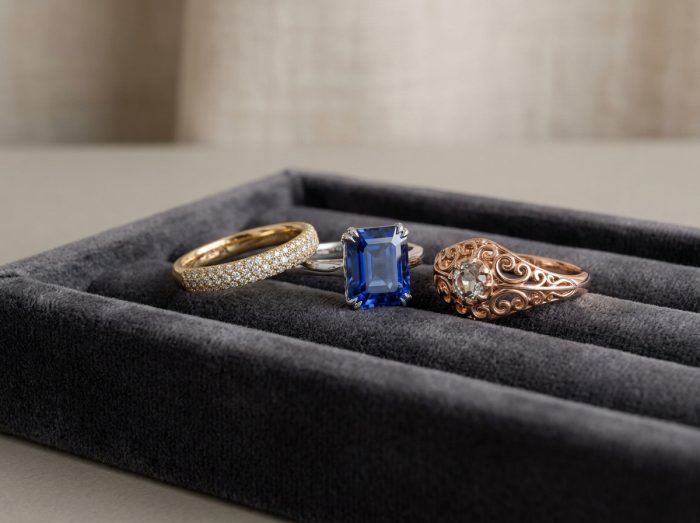
The diamond remains the stone most associated with exceptional rings. Talking about carats is not enough. A poorly cut two-carat diamond of mediocre color will be worth less than a one-carat stone with a perfect cut.
Four criteria determine the quality of a diamond: cut, color, clarity, and carat weight. They are known as the 4Cs. Each influences the final price of the ring, and one weak criterion can significantly lower the value of the entire piece.
Color, for example, is measured on a scale from D (colorless, the rarest) to Z (tinged with yellow). The difference between D and G is invisible to the naked eye for most people, but the price gap is considerable. Choosing a G or H color on a yellow gold setting represents a smart compromise: the warm hue of the metal masks the stone’s nuances.
Cut, the most underestimated criterion
Between a round brilliant diamond and a cushion cut, the perception of light changes completely. The cut determines how the stone reflects and refracts light. A well-cut diamond appears larger and more brilliant than its actual weight suggests.
Experienced jewelers often recommend cut over carat weight. This advice holds true for all price ranges: it’s better to have a smaller stone that is perfectly proportioned.
Signed ring or anonymous creation: the impact on value
Why can two 18-carat gold rings, set with the same type of diamond, have very different prices? The signature of a jewelry house plays a major role.
A signed ring carries the heritage and traceability of a recognized house. The manufacturer’s hallmark, engraved inside the band, attests to its origin. It also guarantees adherence to a strict specification regarding the quality of materials and assembly.
In the resale market, a signed ring from Cartier, Van Cleef & Arpels, or Boucheron retains a significant portion of its initial value. An anonymous creation, even of equivalent quality in terms of metal and stones, depreciates more. The reason lies in trust: the buyer knows what they are purchasing when they recognize a hallmark.
The hallmark, the ring’s identity card
In France, every piece of jewelry in gold or silver must bear a guarantee hallmark. This small symbol stamped into the metal certifies the title (purity) of the precious metal. There are several types:
- The title hallmark, mandatory, indicates the content of fine metal (for example, the eagle’s head for 18-carat gold in France).
- The maker’s mark, specific to the manufacturer, identifies the house or artisan who created the piece.
- The convention mark, applied to imported jewelry, certifies that the piece meets French standards after inspection.
Knowing how to read these marks allows one to distinguish an authentic ring from an imitation and to assess its quality without even looking at the displayed price.
Vintage and second-hand rings: a growing market
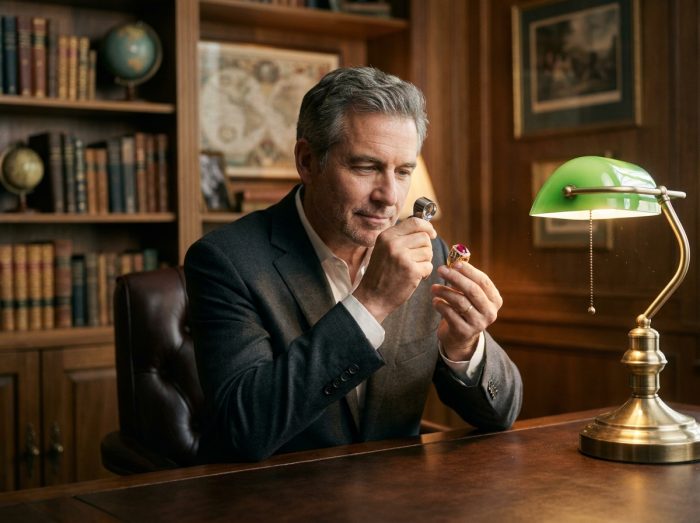
The appeal of luxury rings is not limited to new pieces. The second-hand jewelry market is experiencing marked growth, driven by a clientele seeking both a distinctive style and a responsible purchase.
A well-expertized vintage ring protects just as well as a purchase from a new store, provided that authenticity is guaranteed. Without reliable certification, the buyer risks the quality of the stones, the purity of the metal, or attribution to a house.
The castafiore marketplace has specialized in this niche, with a catalog of over 10,000 expertized and authenticated vintage jewelry and watch pieces before sale. The platform offers rings signed by major Houses as well as unsigned creations, and each piece comes with a digital certificate of authenticity recorded in the blockchain, delivered within 15 days after purchase.
Men’s rings: a segment gaining ground
The 2024 report from De Beers and Bain & Company on the diamond market highlights a trend that was still challenging conventions not long ago: more and more men are buying diamond rings for themselves. The ring becomes a differentiating accessory, a style marker more discreet than a luxury watch.
Several houses have responded to this demand by developing unisex lines. Boucheron, Tiffany, and Cartier offer fine models, set or unset, designed for everyday wear. Men’s engagement rings are also gaining visibility, particularly in North America and Asia.
This shift significantly broadens the audience for luxury rings. It also confirms that the perceived value of a ring no longer depends on the gender of the person wearing it, but on the quality of the piece itself.
Luxury rings continue to attract because they concentrate, in an object of a few grams, measurable craftsmanship and a traceable history. Whether one prefers new or vintage, the signature of a great house or the discretion of a sleek design, the decisive criterion remains the verifiable quality of the piece: its metal, its stones, its hallmark.