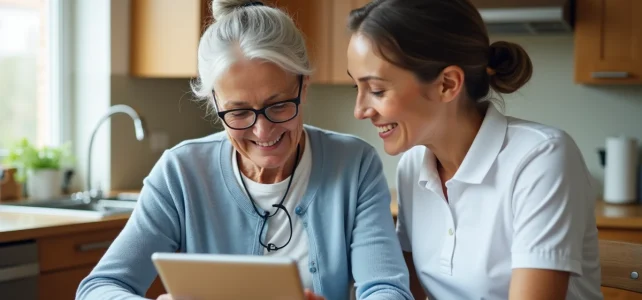
Services for the elderly cover a much broader scope than just household assistance. Daily living support, housing adaptation, fall prevention, coordination between caregivers and professional interveners: these needs constantly overlap. However, most systems still operate in silos, complicating processes for seniors and their loved ones.
The problem of senior services designed in silos
A senior who loses autonomy rarely has a single isolated need. The difficulty in preparing meals is often accompanied by a risk of falling in the kitchen, which is itself linked to poorly adapted housing. Adding a grab bar is not enough if no one coordinates the intervention of the installer, the occupational therapist, and the home care aide.
This siloed operation forces families to multiply their contacts: one organization for household assistance, another for nursing care, a third for renovation work. Each service addresses a need without seeing the overall daily life. The result: duplicates, gaps in support, and an administrative burden that falls on caregivers.
The “Well Aging and Autonomy” law of April 8, 2024, attempts to correct this flaw by creating a Departmental Public Service for Autonomy (SPDA), designed to simplify pathways. Its implementation remains gradual, but the principle is established: a single entry point rather than a mosaic of counters.
To have an overview of the available support, the services offered by Le Senior des Années group various categories of assistance on the same platform, making it easier to identify solutions tailored to each situation.
Housing adaptation and fall prevention: two linked services
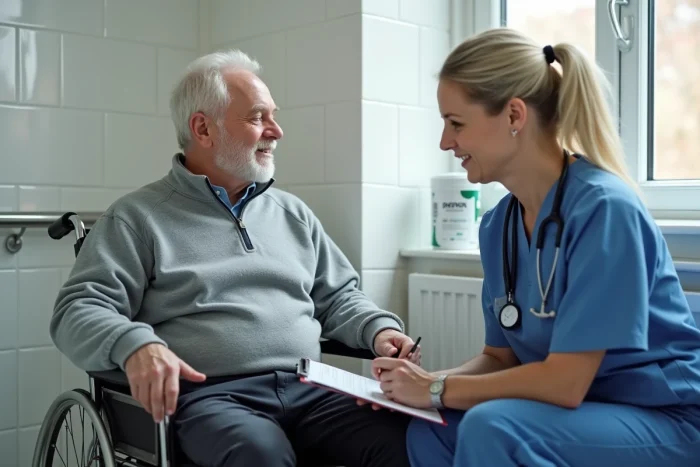
Housing adaptation is often treated as a one-time renovation project. In practice, it is a continuous prevention lever. Fall prevention starts with the arrangement of living spaces, not with an alert bracelet installed after the first accident.
The most common interventions concern the bathroom (walk-in shower, wall-mounted seat, non-slip flooring) and interior circulation (removal of thresholds, automatic lighting, handrails in the hallway). These technical modifications require a prior evaluation of the home by a trained professional.
The problem arises when the adaptation is decided without coordination with home care. A caregiver who intervenes three times a week knows the person’s movement habits, their points of fragility, and the furniture they use for support. Cross-referencing the observations of the professional caregiver with the technical assessment of the occupational therapist produces a more relevant adaptation than an audit conducted in isolation.
What a housing assessment concretely covers
- Evaluation of risk areas: door thresholds, unsecured rugs, bathtubs without handles, stairs without continuous railings
- Verification of the accessibility of everyday equipment: height of cabinets, ergonomics of door handles, distance between the bed and the toilet
- Recommendation of technical aids suited to the level of autonomy: grab bars, toilet risers, medical beds if necessary
Coordination of caregivers: the missing link in traditional systems
The majority of seniors living at home benefit from combined assistance: a relative (spouse, child) and one or more professional interveners (housekeeper, nurse, physiotherapist). Coordination between these actors almost always relies on the family caregiver, via phone, paper communication books, or scattered messages.
Solutions for digital and voice coordination are emerging to structure these exchanges. The goal: to centralize information on a single tool accessible to all interveners, report a change in health status, schedule visits, and avoid missed appointments.
This type of tool does not replace human relationships. However, it prevents situations where the nurse is unaware that the home aide has noted a loss of appetite for several days, or that the physiotherapist has observed a new difficulty in getting up from the chair.
Why family caregivers are exhausted
The lack of formalized coordination turns the family caregiver into an untrained project manager. They manage schedules, relay medical instructions, and chase organizations for care renewals. The exhaustion of caregivers is both administrative and physical.
The SPDA created by the law of April 8, 2024, should ultimately provide comprehensive support that incorporates this coordination dimension. The deployment schedule remains to be clarified according to departments.
Meals, social support, and combating isolation in daily life
Meal delivery at home is the service most recognized by families. Delivery of meal trays adapted to specific diets (low salt, modified textures), this system covers a direct nutritional need.
Social support remains less visible but equally crucial for maintaining home care. The fight against isolation involves friendly visits, accompanied outings, or collective activities organized by local associations. These interventions do not fall under medical care, but they directly contribute to maintaining autonomy.
- Friendly visits: a volunteer or professional regularly comes by to chat, play cards, or accompany a walk
- Accompanied transport: trips to medical appointments, shops, or leisure activities, with assistance getting in and out of the vehicle
- Prevention workshops: memory, balance, nutrition, organized by pension funds or municipal social action centers
The government has also announced a transformation of nursing homes into “Maisons France Autonomie,” with a new set of specifications expected by 2027. This change in terminology reflects a desire to reposition these establishments as open service locations, including for seniors living at home nearby.
The real benefit for seniors and their families will come from the ability to connect these services together. A meal delivery that reports a door left ajar, a home aide who alerts about a dangerous rug, a digital tool that centralizes these observations: it is this continuity, more than the accumulation of separate services, that truly secures daily life at home.