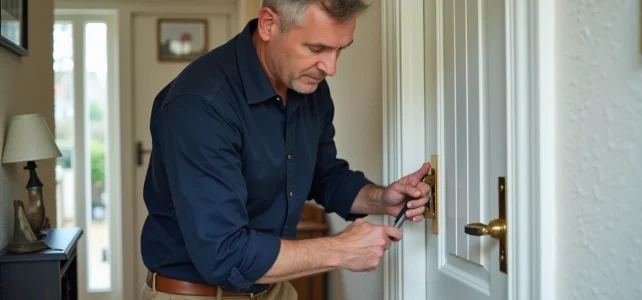
A door that sticks or a stubborn handle are not just minor inconveniences: behind these signs, it can sometimes be the entire thermal balance and security of a home that are at stake. PVC entrance doors, valued for their durability and ease of maintenance, are not exempt from the need for meticulous adjustment. Yet, few master the art of adjusting each contact point or understanding the subtle language of hinges.
Identifying signs of poor adjustment on a PVC entrance door
Noticing that your PVC entrance door has lost its charm is not a matter of instinct, but of paying attention to the details of daily life. When the door scrapes against the tiles, when you have to force the key to turn, or when the cold sneaks in unexpectedly, it indicates that a malfunction has occurred. Sometimes, you may notice a leaf that tilts slightly, or a temperamental closure that requires more effort than usual. A latch that no longer fits into the strike plate as it should, or a handle that resists, are all silent alerts.
These small disturbances are never trivial. A door that no longer seals properly allows moisture in, outside noises infiltrate, and the indoor temperature suffers. The seals themselves do not come out unscathed: sometimes compressed, sometimes too loose, they eventually wear out prematurely. Especially with PVC, even the slightest variation in temperature or humidity can exacerbate these defects, potentially compromising the overall security. A difficult lock, a tired handle, a leaf that no longer closes properly: this is how a simple oversight literally opens the door to intrusions.
To act effectively, one must observe: look at the hinges, note the play between the frame and the door, test the closure at several points. Does the bottom scrape? Does a corner catch? These clues are often enough to guide the intervention on adjusting a PVC entrance door, as described in the specialized guide.
A thorough examination of the components, hinges, strike plate, seals, and handle allows you to pinpoint the cause of the problem. Wear, deformation, misalignment: each anomaly weakens the door and requires prompt action. It is better not to let it linger.
What tools and methods to effectively adjust your door at home?
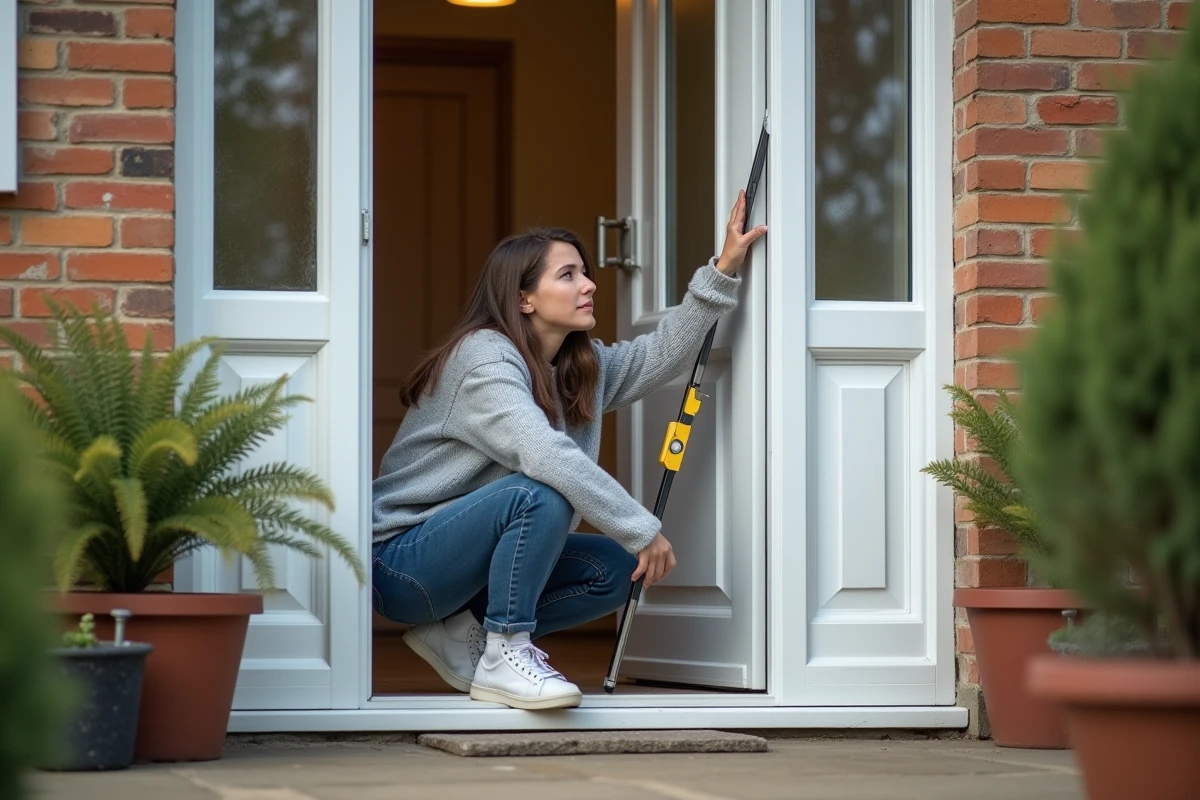
To correct a malfunction, you need to have the right tools: an Allen key, a Phillips screwdriver, a level, and silicone lubricant. These instruments are far from being optional: they quickly become essential for acting precisely on key points, such as hinges or pivots. The adjustment screws, often placed in strategic locations, allow you to adjust the height, lateral alignment, and pressure of the door against the frame.
The adjustment begins with checking the verticality of the door. If it scrapes on the floor or gets stuck on the frame, sagging hinges are likely: simply use the Allen key on the appropriate screw to correct the situation. When the latch refuses to engage easily, the lateral adjustment needs to be reviewed. And if a draft persists or the door seems too loose, the compression must be adjusted to achieve a uniform closure all around.
To check for airtightness, a simple piece of paper slipped between the frame and the seal serves as a tester: if it pulls out easily, the compression needs to be revisited. In case of persistent sagging, an additional washer on the hinge can make a difference.
If despite all these efforts the problem persists, it is better to consider calling a professional, especially for an old or frequently used door. But in the vast majority of cases, a manual adjustment, applied methodically, is enough to extend the lifespan of the door while maintaining its effectiveness.
Detailed steps and tips for stress-free adjustment
Diagnosis and preparation: rigor above all
Before touching the door, a thorough overview is necessary: friction, unusual play, difficult closure are all signals to consider. Start by inspecting the hinges, latch, and strike plate, then focus on the condition of the seals. A tired seal lets in cold and noise, while an excessively compressed seal no longer protects properly. Within reach, you should have an Allen key, a screwdriver, and sometimes a washer to restore support where the door has sagged.
Proceed with the adjustment: method and precision
To raise or lower the leaf, insert the Allen key into the screw dedicated at the base of the hinge, then adjust in small increments, monitoring the alignment each time. If the door is no longer straight laterally, you need to act on the side screw. When the closure remains difficult after all this, the compression needs to be fine-tuned to achieve perfect adhesion between the leaf and its frame. The paper test, slipped and then pulled between the frame and the door, allows you to validate the airtightness.
To better navigate the various actions to be taken, here are the main steps to keep in mind:
- Check the verticality of the door with a level: it should remain stable, without tilting when opened.
- Install an additional washer on the hinge if the door shows signs of sagging.
- Apply silicone lubricant on the axes to eliminate squeaks and facilitate operation.
Regular, meticulous maintenance ensures that the PVC entrance door remains perfectly aligned and easy to operate, while retaining its insulating power and ability to protect the home. Every adjustment made with care translates into years of peace and tangible energy savings. Nothing is more satisfying than a door that slams just right, without resistance or unwanted noise: the subtle sign of a well-maintained home.