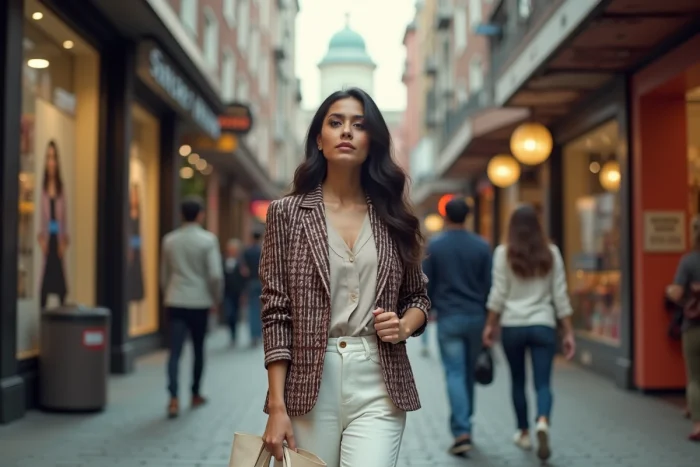
Contemporary fashion is not just a catalog of seasonal silhouettes. It encodes political positions, cultural affiliations, and class relations that digital algorithms redistribute at high speed. Measuring how clothing trends form, circulate, and segment allows us to understand what our clothes say about society, sometimes better than a public opinion poll.
Social Media Algorithms and Clothing Segmentation by Echo Chamber
Recommendation platforms (TikTok, Instagram, Pinterest) do not merely broadcast fashion trends: they fragment them. Each user receives a stream of content tailored to their past interactions, creating impermeable micro-stylistic universes.
A profile sensitive to “clean girl” or minimalist aesthetics will almost never see proposals for engaged streetwear or modest fashion. Clothing trends now form within ideological bubbles, not on a central runway visible to all.
The phenomenon goes beyond mere personal taste. When an algorithm systematically associates a clothing style with a set of values (ecology, patriotism, feminism, conservatism), it reinforces the link between appearance and political identity. Clothing becomes a tribal marker amplified by the machine, and the dialogue between different stylistic groups diminishes.
To delve deeper into the influence of fashion in society, it is essential to integrate this algorithmic dimension, absent from traditional analyses focused solely on designers or fashion shows.
Fashion and Economic Context: What the Minimalism-Maximalism Cycle Reveals
The link between economic state and clothing trends follows a documented pattern. The 2008 crisis caused a 3% increase in global unemployment and a 15% collapse in global trade. Consumers had to rethink their purchases, and brands followed suit.
| Period | Economic Context | Dominant Trend | Clothing Characteristics |
|---|---|---|---|
| Before 2008 | Growth, easy credit | Maximalism | Bright colors, layering, multiple accessories |
| 2008-2015 | Recession, austerity | Minimalism (“recession core”) | Neutral palettes, clean cuts, reduced wardrobes |
| 2020-2023 | Post-pandemic, inflation | Partial return to maximalism | Saturated colors, statement pieces, valued second-hand |
| 2024-2026 | Prolonged uncertainty | Hybridization | Claimed sustainability, AI personalization (Southeast Asia), craftsmanship (Europe) |
This table shows that fashion cycles are not arbitrary but correlated with economic constraints. The death of the colorful aesthetic of the 2000s was not a whim of designers: it reflected a decline in purchasing power that changed buying behaviors on a large scale.
Predictive Personalization vs. Sustainable Craftsmanship
The recent divergence between markets is telling. In Southeast Asia, Gen Z fashion massively integrates artificial intelligence for predictive trend personalization, according to the McKinsey Fashion Report 2026. In contrast, the European market favors an approach centered on sustainable craftsmanship and material traceability.
Two competing models coexist without converging, complicating any unified reading of global trends. A “trendy” garment in Jakarta has little in common with a “trendy” garment in Copenhagen.
Clothing as Political Expression: From Punk to Militant Dress Code
Clothing has always carried sociopolitical messages. Punk and hippie movements used clothing style as a visible act of protest. What is changing today is the speed of appropriation and the scope of dissemination.
- A feminist slogan t-shirt goes from the runway to fast fashion in a matter of weeks, sometimes draining the message of its initial militant substance
- Men’s dress codes are evolving towards what some analysts call “neo-masculinity,” blending traditionally feminine pieces with structured cuts, blurring gender markers
- Modest fashion, driven by diverse religious communities, has generated a commercial segment that major brands are now incorporating into their permanent collections
Clothing remains a means of political expression, but its commercial appropriation is accelerating. The time between the emergence of a dissenting style and its becoming a mass product has shrunk from several years to a few months.

Fashion Industry Responsibility: Working Conditions and Environmental Pressure
The fashion industry employs over 57 million people worldwide, about 80% of whom are women in developing countries. This massive economic reality coexists with structural issues regarding working conditions.
A recent signal deserves attention: the Accord on Building Safety (Accord ACT), which covered around 200 textile factories in Bangladesh in 2023, achieved near-total coverage according to the Clean Clothes Campaign’s quarterly report from January 2026. Worker strikes in Bangladeshi textile factories have significantly decreased since 2025, suggesting a concrete effect of this extension.
Overall Economic Value and Proportional Responsibility
The global value of the fashion sector is estimated to be several trillion dollars. In the UK, this sector alone represents £26 billion. This economic power makes any transformation slow, as margins depend on high volumes and low production costs.
Slow fashion offers an alternative, but it remains a minority in market share. The gap between the sustainability discourse displayed by brands and actual production practices constitutes the main point of tension in the sector in 2026.
Contemporary fashion operates as a system where algorithms, economic context, and political claims interact. The clothes we see in our news feeds are no longer chosen by magazine editors but filtered by recommendation models that reinforce our existing affinities. Understanding this mechanism means reading our societies through what they wear, and especially through what they no longer see.